
Identity & access management
Access is a privilege.
Not an assumption.
Every employee, administrator, application, and machine identity represents a potential route to critical systems. Build a more defensible access model with strong authentication, controlled privileges, and repeatable governance.
CyberPhore · Vancouver, Canada · Security-first advisory approach
Custom visual created specifically to explain CyberPhore’s IAM security approach.
The business problem
Identity security is more than passwords and MFA.
Compromised credentials are only one form of identity risk. Over-permissioned administrator accounts, forgotten contractor access, poorly governed service identities and inconsistent offboarding can all weaken an otherwise mature security program.
The objective is straightforward: establish who or what is requesting access, verify the context, grant only what is required, and retain enough visibility to review or revoke access when circumstances change.
An access decision should be intentional, time-appropriate and accountable—not simply inherited forever.
Security architecture
A practical identity control model.
A well-governed identity program brings together authentication, privileges, account lifecycle and monitoring. The model below illustrates how those controls support one another; it is not a screenshot of a deployed CyberPhore product.
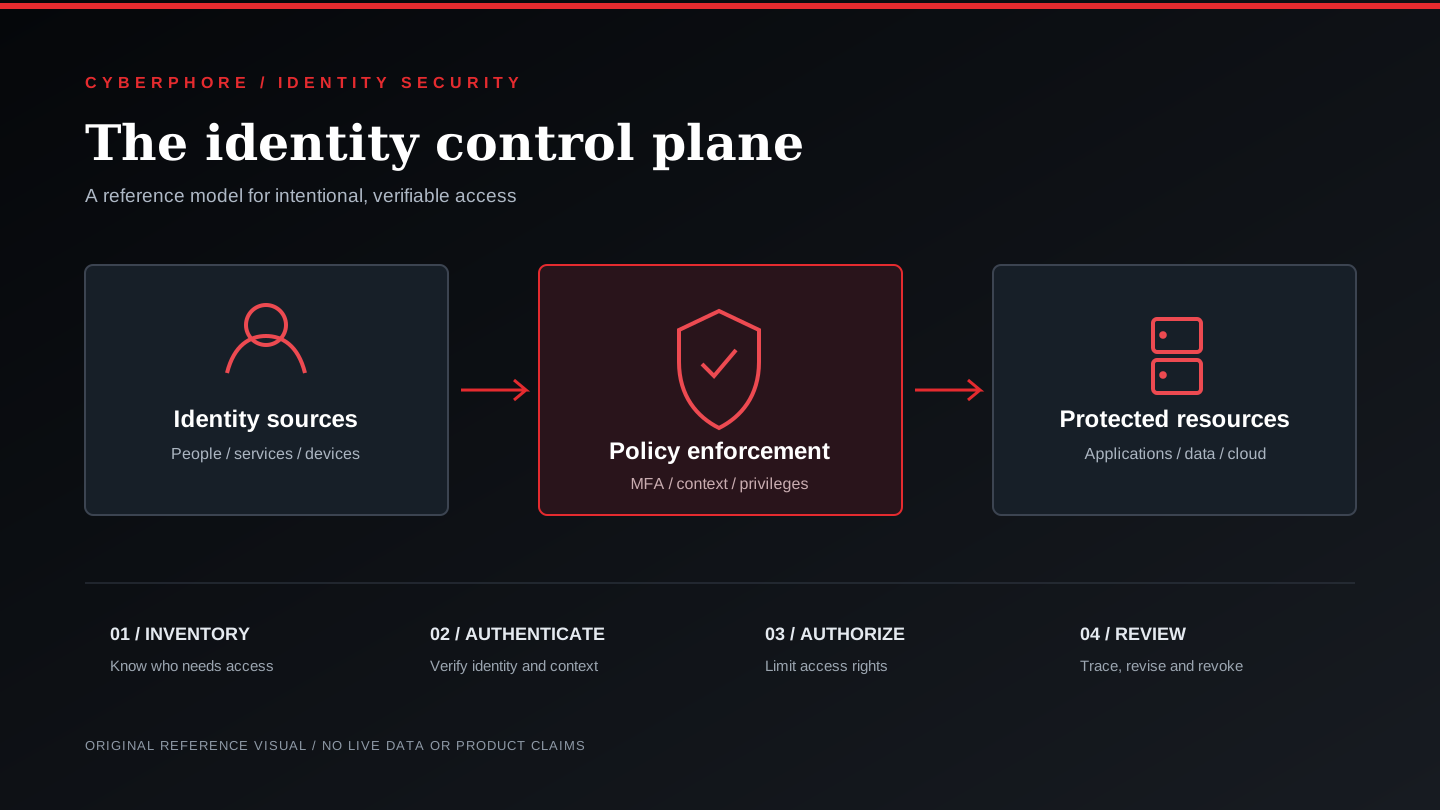
Control every route to sensitive resources.
Start with the identities, applications and privileges that would have the greatest business impact if misused. Define permitted access paths and apply stronger checks where risk warrants them.
- Discover workforce, third-party and non-human identities.
- Enforce appropriate multi-factor and conditional access controls.
- Minimize standing administrative privileges and exceptions.
- Review entitlements when staff and responsibilities change.
- Maintain an auditable record of sensitive access decisions.
Employees, contractors, administrators, service accounts and application identities.
Authentication strength, trusted access context and appropriate session checks.
Least-privilege authorization, high-risk approvals, role boundaries and privileged access.
Account lifecycle, periodic access certification, logging and response readiness.
Original explanatory visualization · No customer data or simulated security scores
Core areas of focus
From identity inventory to sustained governance.
The right priorities depend on the technology, roles, and risk profile of your organization. These four disciplines provide an effective way to organize the work.
Identity posture assessment
Understand the users, groups, administrative roles, connected applications, dormant accounts and weak policies that contribute to avoidable exposure.
Modern authentication
Apply stronger authentication to sensitive workflows, with phishing-resistant methods considered wherever the environment and supported services permit.
Privileged access governance
Reduce broad or permanent administrator rights. Consider dedicated administrator identities, approval-based elevation and appropriate session oversight.
Account lifecycle and reviews
Introduce reliable joiner-mover-leaver processes, access recertification, service-account ownership and timely removal of unnecessary permissions.
How to move forward
A security program, not another disconnected tool.
Successful identity improvements require clear ownership and manageable operational change. A typical roadmap moves from visibility to focused controls, then ongoing validation.
Understand the estate.
Identify business-critical apps, identities, account types, administrative access and current control ownership.
Find meaningful gaps.
Evaluate sign-in strength, excessive roles, inherited privileges, lifecycle weaknesses and high-risk access paths.
Implement deliberately.
Prioritize high-impact changes and validate business continuity as authentication and access policies evolve.
Review and adapt.
Reassess entitlements, exceptions and privileged activity as technology and workforce requirements change.
Questions answered
The important details.
Identity and access controls should be proportionate to your organization’s systems, risks and operational requirements.
What is identity and access management?
IAM is the set of policies, processes and technical mechanisms used to identify people and systems, authenticate them, and govern the digital resources they can access.
Where should a business start?
Identify critical accounts and resources, use stronger authentication for email and administrative access, remove unnecessary privileges, and formalize timely offboarding. Confirm priorities against the actual environment.
Why are service accounts and machine identities important?
Applications, integrations and automation often hold powerful long-lived credentials. Those identities need inventory, ownership, narrowly scoped permissions and credential-management practices just as human accounts do.
Is IAM the same as zero trust?
No. IAM supports a zero trust approach by verifying identities and enforcing access policies, but zero trust also involves devices, applications, networks, data, monitoring and the broader architecture.
Can IAM help with compliance?
Documented access controls, approval records and periodic reviews can support security assurance and regulatory requirements. The specific obligations depend on your organization, industry and jurisdiction.
Further technical reading
Authoritative background: NIST Zero Trust Architecture; CISA phishing-resistant MFA guidance; and Microsoft privileged-access architecture guidance. These references support general security principles; they do not establish a specific CyberPhore technology partnership or service commitment.
Next steps
Discuss your identity security priorities.
Tell us about your critical applications, authentication challenges and access-governance requirements. We can discuss a practical starting point and confirm the scope of available CyberPhore services.