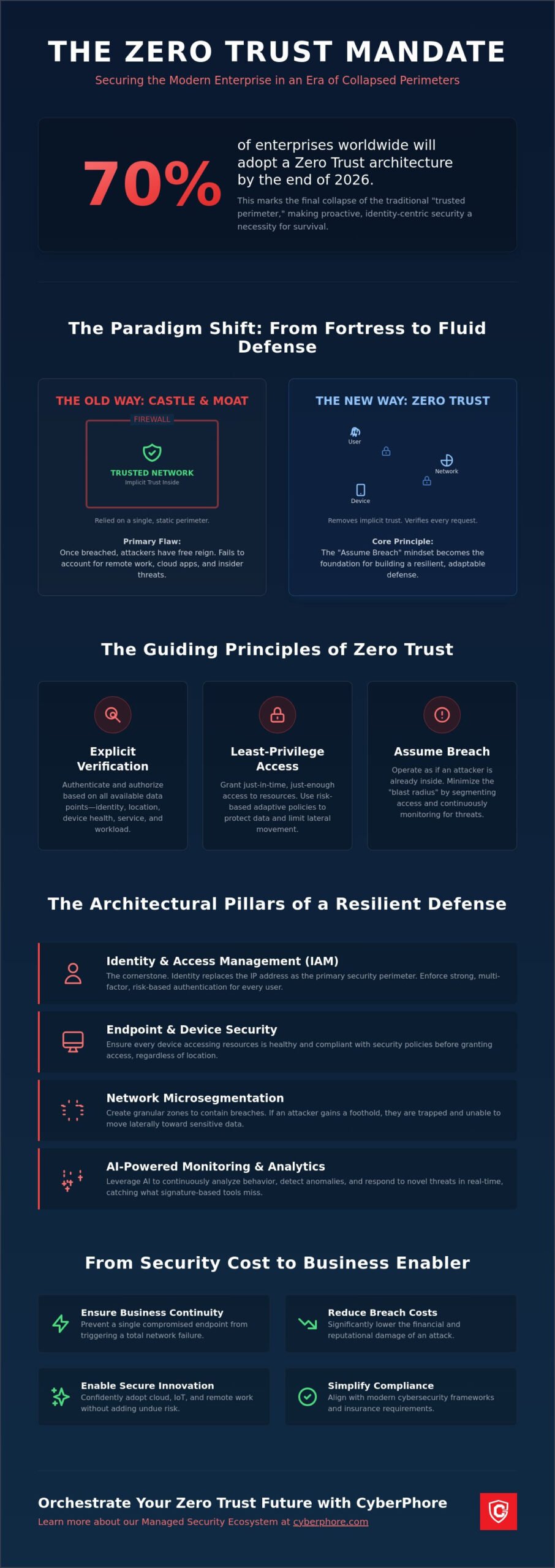
By the end of 2026, 70% of enterprises worldwide will have adopted a Zero Trust architecture, marking the final collapse of the traditional “trusted perimeter.” If you feel that the technical complexity of a zero trust security implementation is a daunting hurdle, you aren’t alone. It’s natural to worry that stricter protocols might disrupt employee productivity or that your internal team lacks the capacity for constant, high-level monitoring. We understand these pressures; security should act as a foundation for your success, not a bottleneck for your innovation.
Need Expert Cybersecurity Help?
Get expert guidance from CyberPhore. We design, deploy, and manage comprehensive cybersecurity programs with measurable outcomes.
Book a Free ConsultationIn this guide, we’ll provide you with a strategic roadmap to transition from outdated defenses to a resilient, AI-driven posture that secures every identity and endpoint. You’ll learn how to leverage the latest NSA guidelines and AI-automated defenses to block lateral movement and ensure business continuity. We’ll walk through a phased plan that simplifies the process, giving you the peace of mind that comes from knowing your organization is protected by a sophisticated, watchful guardian. From strengthening identity controls to enabling continuous monitoring, we’ll show you how to achieve enterprise-grade safety without the typical friction.
Key Takeaways
- Learn why the “assume breach” mindset is the vital starting point for protecting your organization’s digital continuity in 2026.
- Discover how a zero trust security implementation utilizes Identity and Access Management (IAM) to replace implicit trust with explicit verification.
- Explore a phased roadmap designed to provide deep network visibility without creating friction for your employees.
- Understand the role of AI-driven monitoring in blocking lateral movement and managing the complexities of enterprise-grade security tools.
- Find out how a managed security ecosystem provides the 24/7 vigilance needed to secure your web, email, and cloud environments.
Beyond the Perimeter: Why Zero Trust Implementation is Mandatory in 2026
The traditional concept of a “secure perimeter” has become an artifact of the past. As we navigate the complexities of 2026, the explosion of remote work and cloud-native applications has made firewalls a secondary defense at best. A modern zero trust security implementation recognizes that trust itself is a vulnerability that attackers frequently exploit. Instead of assuming that anything inside the network is safe, this model removes implicit trust entirely. It treats every access request as a potential threat until it is verified, regardless of where that request originates.
This shift is driven by a threat landscape where AI-powered exploits can bypass legacy defenses with startling speed. Relying on a single entry point for protection is no longer a viable strategy for any organization. By adopting an “Assume Breach” mindset, you start from the position that an attacker may already be present within your environment. This perspective isn’t about being alarmist; it’s about being prepared. It allows you to build a resilient foundation that remains functional and safe even when specific components are under pressure.
In 2026, the velocity of cyberattacks has reached a point where manual intervention is often too slow. Generative AI is now used by adversaries to launch polymorphic malware and highly targeted phishing campaigns that bypass traditional filters. An automated, intelligent response is the only way to counter these high-speed threats. Your security must be a vigilant guardian that is as adaptable as the technology it protects.
The Core Philosophy: Never Trust, Always Verify
Zero Trust is a dynamic, policy-driven architecture that continuously evaluates risk rather than a static product you deploy once. It relies on three fundamental pillars: explicit verification, least privileged access, and the constant assumption of a breach. Within this framework, identity has officially replaced the IP address as the primary security perimeter. Every user and device must prove its legitimacy through Zero Trust Architecture (ZTA) principles before gaining access to specific resources.
The Business Case for Resilience
A robust zero trust security implementation directly supports business growth by ensuring continuity and facilitating insurance compliance. By blocking lateral movement, you ensure that a single compromised endpoint cannot trigger a total network failure. This containment strategy protects your most valuable assets and maintains customer trust. Ultimately, the cost of maintaining a proactive, automated defense is significantly lower than the financial and reputational damage caused by a major data breach.
The Architectural Pillars of a Managed Zero Trust Strategy
Building a robust security posture requires more than just installing software. A successful zero trust security implementation relies on several interconnected pillars that work in harmony to protect your digital assets. It starts with Identity and Access Management (IAM), which acts as the gatekeeper for every resource. By moving away from static passwords to dynamic, risk-based authentication, you ensure that only the right people have access to the right data at the right time.
This approach aligns with the latest NIST guidance on Zero Trust, which emphasizes that security should be applied at the level of individual transactions. Once identity is verified, endpoint protection and network microsegmentation provide the next layers of defense. Microsegmentation breaks the network into small, isolated zones. This ensures that even if an intruder gains access to one area, they’re trapped within a single segment, unable to move laterally toward your sensitive data.
A vigilant 24/7 Security Operations Center (SOC) serves as the heartbeat of this entire operation. Without continuous monitoring, the “always verify” principle cannot be maintained in real time. This constant watchfulness provides the peace of mind that your organization is defended against even the most sophisticated actors. It allows you to focus on growth while we handle the complexities of your defense.
AI-Driven Behavioral Analytics
AI is the engine that makes continuous validation possible in 2026. Traditional signature-based tools often fail to catch novel, zero-day exploits because they only look for known patterns. AI-driven behavioral analytics, however, identifies anomalies in real-time. It watches for subtle shifts in user behavior or device activity that suggest a compromise. CyberPhore integrates these AI-powered detection capabilities to provide an enterprise-grade defense that stays ahead of evolving threats.
Securing the Cloud and Email Vectors
A comprehensive zero trust security implementation doesn’t just stop at the office door; it must extend into AWS, Azure, and Google Cloud environments. This involves continuous configuration auditing to ensure that cloud resources aren’t left exposed. Email security is equally critical, as it remains the primary entry point for identity theft. By blocking phishing attempts before they reach the inbox, you stop attacks before they can even begin. Our experts can help you refine your Endpoint Protection and cloud strategy to ensure no gap is left unguarded.
A Phased Roadmap for Implementing Zero Trust Without Friction
Success in 2026 requires a shift from viewing security as a product to seeing it as a managed operational posture. A successful zero trust security implementation isn’t an overnight switch; it’s a methodical transition that ensures safety without compromising performance. To help you navigate this evolution, we’ve developed a phased implementation roadmap that prioritizes continuity. This journey begins with total visibility and matures into an AI-orchestrated defense system that protects every digital interaction.
The process follows five critical stages to ensure a seamless transition. First, you must establish an inventory because you cannot protect assets you can’t see. Second, you fortify identities using multi-factor authentication and least-privileged access. Third, you isolate critical business workloads through granular segmentation. Fourth, you implement continuous validation through 24/7 monitoring. Finally, you optimize your policies by analyzing behavioral data to refine your defense.
Phase 1: Discovery and Vulnerability Assessment
Before deploying new controls, you need a clear understanding of your current environment. A baseline assessment identifies existing gaps and maps data flows to show how users interact with sensitive information. This visibility is the foundation of a resilient posture. We recommend starting with CyberPhore’s vulnerability assessment services to pinpoint exactly where your defenses need fortification. By uncovering hidden risks early, you prevent costly disruptions during the later stages of your implementation.
Segmenting your network is the next logical step in containing potential threats. By isolating critical business assets, you prevent an attacker from moving from a low-risk endpoint to your most sensitive databases. This containment strategy is what transforms a potential crisis into a manageable incident. Once these barriers are in place, continuous validation becomes the heartbeat of your defense. A dedicated SOC monitors every request and behavior around the clock, providing the constant watchfulness required to verify trust in real-time.
Phase 2: Operationalizing Least Privilege
One of the most common fears regarding Zero Trust is the potential for employee friction. However, restricting administrative access doesn’t have to hinder productivity. By using Just-In-Time (JIT) access, you provide elevated permissions only when they are needed for a specific task. This approach minimizes the attack surface without slowing down your team. Intelligent automation allows you to balance high-level security with a seamless user experience, ensuring that your zero trust security implementation supports, rather than stifles, your business growth.
Protect Your Business Now
From detection to response, get complete protection with CyberPhore.
Get ProtectedOvercoming the Implementation Gap: Cost, Complexity, and Culture
Many organizations hesitate to begin a zero trust security implementation because they equate advanced protection with prohibitive costs. This common misconception often stems from the belief that enterprise-grade security requires a massive internal infrastructure and a fleet of specialized engineers. In reality, the most significant barrier isn’t the technology itself but the perceived complexity of managing it around the clock. By shifting from a do-it-yourself model to a managed partnership, you gain the strength of a seasoned protector without the overhead of a large-scale capital investment.
The gap between knowing you need better security and actually deploying it often comes down to resources. Most businesses don’t have the luxury of building a private Security Operations Center (SOC). Partnering with a managed provider acts as an “easy button,” allowing you to bypass the steep learning curve and immediate talent shortages. This approach transforms a daunting technical project into a steady, reliable support system that grows alongside your business.
Affordable Enterprise-Grade Security
A managed subscription model offers a predictable and sustainable way to secure your organization. Building an in-house SOC involves massive expenses for software licenses and the high salaries of specialized analysts. CyberPhore provides an affordable alternative that brings high-level technology to businesses that previously felt priced out of the market. We believe that constant vigilance is a foundational right for every business, and 24/7 monitoring shouldn’t be a budget-breaker.
Simplifying the Technical Stack
Tool sprawl is a frequent pitfall that leads to fragmented visibility and wasted budget. Many teams purchase separate products for email, network, and endpoint protection, only to find these tools don’t communicate effectively. A managed zero trust security implementation focuses on integration rather than just accumulation. We handle the heavy lifting of log analysis and incident containment so your team can focus on innovation. You don’t need to replace all your hardware to adopt this model; it’s about how your existing assets are orchestrated and verified.
Technology is only half the battle. Your people are the other. Educating employees on their role as the first line of defense turns a potential vulnerability into a position of strength. When your team understands why they’re being asked to verify their identity, they become active participants in your company’s continuity. This cultural shift, combined with a resilient posture, significantly reduces breach impact and helps lower cyber insurance premiums. If you’re ready to simplify your defense and protect your bottom line, explore our Managed Security Services to see how we bridge the implementation gap for you.
Orchestrating Zero Trust with CyberPhore’s Managed Security Ecosystem
Real security is found in the space between advanced technology and human vigilance. While the roadmap we’ve discussed provides the direction, CyberPhore’s Managed Security Ecosystem provides the engine and the watchful eyes necessary to maintain a resilient posture. A comprehensive zero trust security implementation succeeds only when it’s supported by constant, expert oversight that understands your unique business environment. Our Canadian-based SOC operates as your dedicated guardian, providing 24/7 AI-driven monitoring that identifies and neutralizes threats before they can disrupt your operations.
Our approach covers every critical vector, including your website, email, network, and cloud environments. By integrating these disparate areas into a unified defense, we eliminate the blind spots that attackers often exploit. If an anomaly is detected, our expert incident response team acts immediately to contain the threat and minimize impact. This proactive containment is the physical manifestation of the “Assume Breach” mindset, ensuring that a minor incident never escalates into a company-wide crisis. To keep you informed, we provide regular security posture reporting that ensures ongoing compliance and tracks the evolution of your defense standards.
The CyberPhore Advantage: Your Vigilant Guardian
We believe that the best defense combines the speed of AI with the nuanced judgment of certified human experts. This partnership allows us to filter out the noise of false positives while focusing on the behavioral anomalies that truly matter. As your proactive ally, we simplify the digital landscape for you, acting as a shield that allows you to focus on your own progress and innovation. Our 24/7 incident response serves as a permanent safety net for your implementation, offering you the steadying presence required in a high-stakes environment. You gain the confidence of a leader who is prepared for any eventuality.
Getting Started with Your Zero Trust Journey
Every journey toward a resilient posture begins with a clear understanding of the present. The first step in our partnership is a comprehensive security audit and vulnerability scan. This initial assessment allows us to pinpoint gaps and tailor a Zero Trust roadmap that fits your specific operational needs and business goals. We don’t believe in one-size-fits-all solutions. Instead, we build a foundation that supports your growth while keeping you safe from every angle. It’s time to move beyond outdated perimeters and embrace a future of constant, reliable protection. Secure your business with CyberPhore’s managed 24/7 protection.
Securing Your Digital Evolution with Confidence
Adopting a zero trust security implementation is the most decisive step you can take to ensure your organization’s resilience in 2026. By moving away from the fragile “trusted perimeter” and embracing a model of continuous, AI-driven verification, you create a foundation that supports both safety and growth. This transition isn’t just about technical shifts; it’s about building a culture of watchfulness that protects every identity and endpoint without hindering your team’s productivity.
CyberPhore acts as your proactive ally, providing affordable enterprise-grade security that was once reserved only for the largest corporations. Our Canadian-based SOC offers global 24/7 coverage, combining human expertise with advanced AI-powered threat detection and rapid incident response. We manage the high-stakes complexity of modern defense so you can focus on your own innovation. Protect your business with CyberPhore’s 24/7 AI-driven security.
The path to a resilient posture is clear, and you don’t have to walk it alone. We’re here to provide the steady, constant protection your business deserves as it moves forward into a secure and prosperous future.
Frequently Asked Questions
What is the first step in a Zero Trust security implementation?
The first step is conducting a comprehensive inventory of your users, devices, and data. You can’t protect what you can’t see, so mapping your “protect surface” is essential before applying any policies. This discovery phase involves identifying every endpoint and understanding how data flows across your network. Starting with a vulnerability assessment helps pinpoint existing gaps and provides a clear baseline for your security evolution.
Is Zero Trust security only for large enterprises?
Zero Trust is a foundational security model that benefits organizations of all sizes. While large enterprises were early adopters, the rise of managed security services has made this architecture accessible and affordable for small and medium businesses. Every company faces risks from identity theft and lateral movement, making a resilient posture a business necessity rather than a luxury reserved for the elite.
How does Zero Trust affect the employee login experience?
Modern implementations actually simplify the user experience by using Single Sign-On (SSO) and intelligent automation. While users must verify their identity through multi-factor authentication, they often face fewer repetitive login prompts once their context is established. By using risk-based authentication, the system only requests additional verification when it detects an anomaly, ensuring that security supports productivity instead of creating friction.
Can Zero Trust prevent ransomware attacks effectively?
A zero trust security implementation is exceptionally effective at containing ransomware by preventing lateral movement. In a traditional network, an attacker who compromises one laptop can often reach the entire server room. Zero Trust isolates critical assets, ensuring that even if one endpoint is breached, the infection remains trapped in a single, granular segment. This containment strategy prevents a minor incident from becoming a company-wide catastrophe.
What is the difference between ZTNA and a traditional VPN?
A traditional VPN grants a user broad access to the entire network once they pass the perimeter. In contrast, Zero Trust Network Access (ZTNA) follows the principle of least privilege, granting access only to specific applications required for a task. This creates a much smaller attack surface. ZTNA continuously verifies the user’s identity and device health, whereas a VPN often trusts the connection indefinitely once established.
How much does it cost to implement Zero Trust for a small business?
Costs vary based on the size of your environment and the complexity of your existing stack. However, adopting a managed security model is significantly more cost-effective than building an in-house Security Operations Center. Small businesses can achieve enterprise-grade protection through subscription-based services that include 24/7 monitoring and incident response. This approach replaces high capital expenditures with a predictable operating cost that scales with your growth.
Does Zero Trust require replacing all our existing security hardware?
You don’t need to rip and replace your existing infrastructure to adopt this model. Zero Trust is an architectural framework that often integrates with your current tools through software-defined policies and cloud-based controls. While you may eventually phase out legacy firewalls, the initial transition focuses on orchestrating your existing assets more effectively. It’s about how you verify and control access rather than just the hardware you use.
How does AI improve the effectiveness of a Zero Trust architecture?
AI serves as the engine for continuous validation by analyzing vast amounts of behavioral data in real-time. It detects subtle anomalies that human analysts or signature-based tools might miss, such as a user logging in from an unusual location at an odd hour. Within a zero trust security implementation, AI-driven analytics allow for automated threat detection and incident response, providing the high-speed defense necessary to counter modern, automated exploits.
Ready to Get Started?
Talk to CyberPhore's team. We'll assess your needs and design a custom solution.
Free Security Assessment