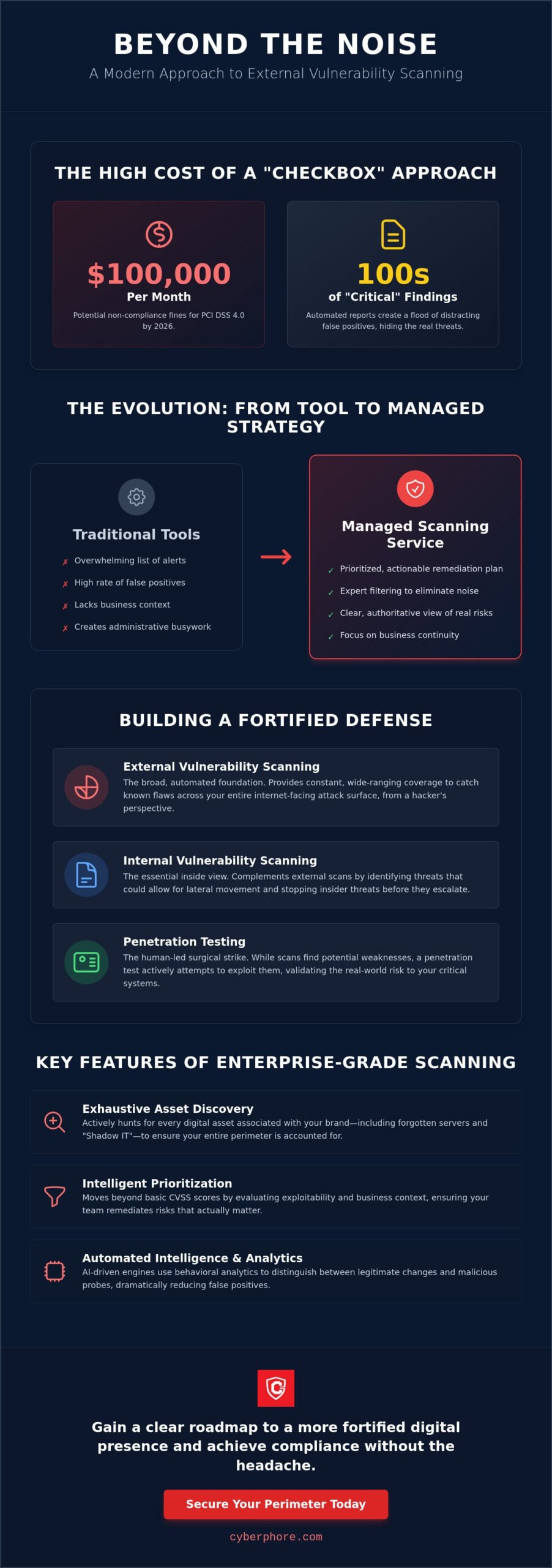
With non-compliance fines for PCI DSS 4.0 reaching up to $100,000 per month in 2026, treating security as a periodic checkbox is no longer a viable strategy for sustainable growth. You likely feel the weight of this responsibility every time a new automated report lands on your desk, filled with hundreds of “critical” findings that often turn out to be distracting false positives. It’s exhausting to filter through the noise when your primary goal is simply to keep the front door locked. Utilizing professional external vulnerability scanning services shouldn’t add to your daily burden; it should provide the clarity you need to act with confidence. We recognize that your expertise is better spent on business innovation rather than chasing digital ghosts.
Need Expert Cybersecurity Help?
Get expert guidance from CyberPhore. We design, deploy, and manage comprehensive cybersecurity programs with measurable outcomes.
Book a Free ConsultationThis article explores how expert external vulnerability scanning identifies hidden security gaps before attackers can exploit them, ensuring your business remains both resilient and compliant. We’ll demonstrate how to move beyond basic automation toward a prioritized risk strategy that secures your entire global attack surface. You’ll discover how to achieve SOC2 and PCI readiness without the typical administrative headaches, gaining a clear roadmap to a more fortified digital presence. By the end, you’ll have the peace of mind that comes from a steady, watchful defense.
Key Takeaways
- Shift from reactive tool-based scanning to a managed strategy that offers a clear, authoritative view of your network’s perimeter.
- Identify and secure hidden or forgotten digital assets through professional external vulnerability scanning services to eliminate “shadow IT” risks.
- Transition from overwhelming lists of vulnerabilities to a prioritized remediation plan based on real-world impact and business continuity.
- Balance your security posture by combining the hacker’s external perspective with internal insights to stop lateral movement and insider threats.
- Follow a structured two-step framework to map your global attack surface and execute deep-packet scans for a more fortified defense.
What are External Vulnerability Scanning Services?
External vulnerability scanning services provide a systematic review of your network’s perimeter to identify security weaknesses visible from the public internet. This outside-in perspective is vital for modern, remote-first businesses that no longer operate within the safety of a physical office. A vulnerability scanner acts as the primary engine in this process, but the service itself involves much more than just clicking a button. It’s about understanding how a hacker sees your organization from the outside and identifying the gaps before they can be exploited.
There’s a significant difference between owning a software tool and utilizing a managed service. A tool will often generate an overwhelming number of false positives, leaving your team with a list of “critical” findings that lack context. A managed service approach provides a steadying presence, filtering through the noise to deliver a prioritized list of real risks. External vulnerability scanning serves as a foundational shield for your digital assets, providing a constant watch over every internet-facing gateway. This professional oversight ensures that your security efforts remain focused on business continuity rather than administrative busywork.
The Evolution of the Attack Surface in 2026
The digital footprint of the average enterprise has expanded significantly. By 2026, cloud expansion and the integration of IoT devices have blurred the traditional network perimeter. Malicious actors now deploy sophisticated, automated bot scans that probe for weaknesses every second of every day. Because software is now released and updated at a rapid pace, periodic scans are no longer sufficient. You need a solution that evolves alongside your technology, ensuring that new cloud instances or remote endpoints don’t become accidental backdoors into your environment.
Vulnerability Scanning vs. Penetration Testing
Understanding the distinction between these two services is essential for a complete defense. Vulnerability scanning is the broad, automated foundation of your security posture. It provides constant, wide-ranging coverage to catch known flaws across your entire external surface. Penetration testing, however, is a human-led surgical strike. While the scan identifies potential weaknesses, the tester attempts to exploit them to see how far an attacker could actually get. These services complement each other perfectly; the scan provides the constant watchfulness, while the penetration test offers the deep-dive validation needed for high-stakes compliance and risk management.
Key Features of Enterprise-Grade External Scanning
Enterprise-grade external vulnerability scanning services provide more than just a list of open ports; they offer a comprehensive map of your organizational exposure. The most effective solutions begin with exhaustive asset discovery. In a modern environment, “shadow IT” often represents your greatest risk. This includes development servers, forgotten marketing microsites, or cloud instances created outside of official procurement channels. By 2026, a vigilant guardian doesn’t just scan known IP addresses. It actively hunts for every digital asset associated with your brand, ensuring that no “forgotten” gateway remains open to attackers. This thoroughness provides the foundational peace of mind that your entire perimeter is accounted for.
Once assets are identified, intelligent prioritization becomes the focus. Traditional tools often bury IT teams under an avalanche of high CVSS scores that don’t reflect real-world danger. A sophisticated service moves beyond these basic metrics by evaluating the exploitability and business context of each finding. If a vulnerability exists on a non-critical system with no path to sensitive data, it shouldn’t distract you from a lower-scored flaw on a mission-critical server. This methodical approach ensures your team spends time remediating risks that actually matter, rather than chasing digital ghosts. It’s about clarity and the efficient use of your limited resources.
Automated Intelligence and Behavioral Analytics
Modern scanning has transitioned from static checks to dynamic analysis. By 2026, AI-driven engines have become essential for reducing the false positives that traditionally plague automated reports. These systems use behavioral analytics to distinguish between a legitimate configuration change and a malicious probe. Context-aware scanning understands the unique “heartbeat” of your network, allowing it to provide more accurate alerts. This level of intelligence is a core component of a total security ecosystem, acting as a proactive shield that evolves alongside emerging threats.
Compliance and Regulatory Alignment
Meeting the rigorous demands of PCI DSS 4.0, HIPAA, and GDPR requires more than just good intentions; it requires audit-ready documentation. External vulnerability scanning services are specifically designed to satisfy these high-stakes requirements. For organizations handling payment data, utilizing an Approved Scanning Vendor (ASV) is a non-negotiable standard. These services generate detailed, professional reports tailored for both technical remediation and executive oversight. They provide the evidence your stakeholders and insurers need to see, proving that your “front door” is not only locked but monitored with constant watchfulness. This alignment simplifies the compliance process, removing the headache of manual reporting while maintaining the highest standards of safety.
Internal vs. External Scanning: Why You Need Both
Achieving true digital resilience requires a dual-lens approach to your infrastructure. While external vulnerability scanning services act as your primary line of defense, they only tell half the story. A secure perimeter is useless if the interior is unprotected. To build a robust security posture, you must understand both how an attacker sees your organization from the sidewalk and how they might move through your hallways if they manage to step inside. This layered visibility is what separates a basic compliance effort from a truly fortified enterprise.
Internal scanning focuses on identifying lateral movement risks and potential insider threats that exist behind your firewall. It examines the vulnerabilities residing on your internal workstations, local servers, and core databases. If a single employee’s credentials are compromised through a phishing attempt, an internal scan reveals whether that attacker can jump from a low-level desktop to your sensitive financial systems. By combining these insights with your external findings, you create a unified vulnerability management program. This methodical synergy ensures that your team isn’t just protecting the “front door,” but is also securing the valuable assets kept within the vault.
The ‘Outside-In’ Methodology
Professional external vulnerability scanning services simulate the initial reconnaissance phase of a real-world cyberattack. This methodology focuses on your most visible assets, including web servers, firewalls, and public-facing APIs. By 2026, these scans have become increasingly vital for identifying misconfigured cloud buckets or exposed credentials that often leak into the public domain. It’s a disciplined process of probing your defenses to ensure that every gateway is sealed tight against the sophisticated automated bots that roam the internet. This perspective allows you to fix the gaps that an attacker would find first, effectively stopping an incident before it begins.
Bridging the Gap with Zero-Trust Architecture
The data gathered from your vulnerability scans shouldn’t exist in a vacuum; it should actively inform your zero-trust access policies. In a zero-trust model, no user or device is trusted by default, regardless of their location. By using scan results to harden endpoints before they connect to the core network, you ensure that only the most secure devices are granted access. CyberPhore integrates this vulnerability data with proactive network monitoring to create a dynamic, multi-layered defense. This approach doesn’t just find flaws; it uses that intelligence to build a smarter network that adapts to the specific risks identified across your global attack surface, providing the steadying presence your business needs to grow safely.
Protect Your Business Now
From detection to response, get complete protection with CyberPhore.
Get ProtectedImplementing an Actionable Remediation Framework
Identifying vulnerabilities is only the first step in a larger lifecycle of protection. To move from a state of awareness to a state of resilience, you need a methodical framework that turns raw data into decisive action. Professional external vulnerability scanning services provide the baseline, but the remediation process ensures the “front door” stays locked. This isn’t a one-off event; it’s a continuous cycle of discovery, validation, and fortification that allows your business to grow without the constant fear of an overlooked gap.
A structured remediation workflow typically follows these five essential stages:
- Step 1: Discover and map every external-facing digital asset to create a comprehensive inventory, including those forgotten cloud instances or marketing sites that often slip through the cracks.
- Step 2: Execute deep-packet and configuration-level scans to probe beyond surface-level ports and identify underlying flaws in how your services are exposed.
- Step 3: Analyze results using AI-driven risk scoring that considers business context, helping you understand which vulnerabilities are actually reachable by modern attackers.
- Step 4: Execute a prioritized remediation plan that focuses on exploitability, ensuring your team addresses the most dangerous gaps first rather than working through a random list.
- Step 5: Re-scan to verify that the intended “door” is officially closed, providing the documented proof required for compliance and executive peace of mind.
Prioritizing the ‘Critical’ Few
In a complex network, you’ll likely face an overwhelming number of “High” or “Critical” findings. However, not every high-scoring vulnerability presents an immediate threat to your specific business. By correlating scan data with active threat intelligence, you can identify which flaws are currently being exploited in the wild. This intelligence-led approach reduces alert fatigue for your internal IT teams, allowing them to focus on the small percentage of risks that truly matter. It’s about working smarter, not harder, to maintain a high standard of safety.
The Role of Managed Security Partners
Transitioning from reactive patching to proactive posture management is a significant shift for any organization. A managed security partner acts as a seasoned extension of your team, providing the constant watchfulness that internal departments often lack the time to maintain. This partnership moves beyond simple reporting; it provides the expert analysis needed to interpret complex scan results. By choosing professional vulnerability assessment services, you gain a vigilant guardian that monitors your perimeter 24/7, catching emerging threats before they can be exploited. This steady, supportive presence allows you to focus on your core business goals while we handle the complexities of your digital defense.
CyberPhore: Your Global Partner in Vigilant Defense
CyberPhore acts as a vigilant guardian for your digital perimeter, integrating AI-driven external vulnerability scanning services into a total security ecosystem. We understand that automated reports alone don’t provide safety; they often provide noise. Our Canadian-born, global-ready team filters that noise through our 24/7 Security Operations Center (SOC), delivering expert analysis that goes far beyond what a basic tool can offer. We provide affordable, enterprise-grade protection that scales with your ambition, ensuring that businesses of all sizes can operate with the quiet confidence of a fully fortified network. This isn’t just about finding flaws; it’s about providing a steady, supportive presence that allows you to focus on your core mission.
Our methodology combines high-level technology with human-centric expertise. We recognize that your business continuity depends on more than just a software scan. By positioning our service as a foundational support system, we help you navigate the complexities of the digital landscape with ease. Our team takes pride in being a proactive ally, acting as a shield that stays one step ahead of potential threats. This methodical approach reinforces your image as a stable and enduring partner to your own clients, linking your safety directly to your ongoing success and innovation.
The CyberPhore Advantage: Beyond the Scan
Our approach is rooted in the belief that security should be seamless. By integrating our scanning data with our Managed Network Security Monitoring, we create a layered defense that recognizes threats in real-time. If our external vulnerability scanning services identify a new gateway or exposure, our Incident Response team immediately incorporates that intelligence into our containment strategies. This proactive methodology ensures that your defense evolves as quickly as the threats themselves. We provide customized reporting that translates technical risks into the language of business growth, allowing your leadership to make informed decisions without getting bogged down in impenetrable jargon.
Securing Your Future Today
Waiting for a breach to occur is the most expensive security strategy a business can adopt. The financial and reputational costs of a single incident far outweigh the investment in a steady, watchful defense. Partnering with a dedicated security ally provides the peace of mind needed to focus on your own progress and innovation. We take pride in our role as a defender, simplifying the complexities of modern cybersecurity for the benefit of our partners. It’s time to transition from a reactive posture to a state of permanent resilience. Secure your perimeter with a CyberPhore Vulnerability Assessment and experience the reliability of a partner who is already prepared for any eventuality.
Fortifying Your Digital Perimeter for the Future
Securing a global attack surface requires a transition from periodic checklists to a state of constant, vigilant defense. You’ve learned that effective external vulnerability scanning services provide more than just a list of flaws; they offer a prioritized roadmap that balances technical risk with business continuity. By integrating comprehensive asset discovery with intelligent remediation, you can eliminate shadow IT and ensure your compliance standing remains beyond reproach. This methodical approach transforms security from a source of stress into a foundational pillar of your organization’s growth.
CyberPhore stands ready as your seasoned expert and proactive ally in this journey. Our methodology leverages AI-powered threat detection and zero-trust architecture integration to create a robust, multi-layered shield for your enterprise. With 24/7 Security Operations Center (SOC) access, you gain the peace of mind that comes from a protector who is always prepared. It’s time to move forward with the confidence that your “front door” is not only locked but watched with unwavering attention.
Request Your Proactive Vulnerability Assessment from CyberPhore today and take the first step toward a more resilient tomorrow. We look forward to helping you grow safely and securely.
Frequently Asked Questions
How often should my business perform an external vulnerability scan?
Your business should perform an external scan at least quarterly, though a continuous monitoring approach is the modern standard for 2026. Regulatory frameworks like PCI DSS 4.0 mandate quarterly scans conducted by an Approved Scanning Vendor (ASV). However, because your global attack surface changes whenever you update software or add cloud instances, a monthly or continuous cadence provides a more reliable shield against emerging threats.
Is an external vulnerability scan the same as a penetration test?
No, a vulnerability scan is an automated process designed to identify known security flaws across your perimeter. While scans provide broad and constant coverage, a penetration test is a manual, human-led engagement where ethical hackers attempt to exploit those flaws. Think of scanning as the foundation of your security posture and penetration testing as the deep-dive validation of your defenses.
Can external scanning services help with PCI DSS compliance?
Yes, professional external vulnerability scanning services are a core requirement for any organization that processes cardholder data. Under PCI DSS 4.0, businesses must pass quarterly external scans performed by an ASV to maintain their compliance status. These services generate the specific documentation and technical evidence required by auditors and banks to prove that your “front door” is properly secured.
What happens if a critical vulnerability is found during a scan?
When a critical vulnerability is identified, our 24/7 Security Operations Center provides an immediate alert and a prioritized remediation plan. We analyze the finding within your specific business context to determine if it’s reachable and exploitable by attackers. Once your team applies the necessary patch or configuration change, we perform a re-scan to verify that the risk has been successfully neutralized.
Do external scans disrupt our website or network performance?
Standard external scans are designed to be non-intrusive and typically have no noticeable impact on your website or network performance. We configure our tools to probe your systems at a controlled pace, simulating normal traffic patterns while identifying weaknesses. This allows us to maintain a constant watch over your environment without interrupting your daily operations or affecting the user experience for your customers.
How long does a typical external vulnerability assessment take to complete?
A typical scan can take anywhere from a few hours to several days, depending on the complexity and size of your external-facing infrastructure. Small environments with a few IP addresses are processed quickly, while large, global networks require more time for thorough asset discovery and deep-packet analysis. We ensure the process is methodical and complete, providing you with an accurate map of your exposure.
What is the difference between an automated scan and a managed scanning service?
An automated scan is a software tool that generates a raw list of findings, while a managed service includes expert analysis and prioritization. Managed external vulnerability scanning services reduce alert fatigue by filtering out false positives and focusing your attention on real-world risks. This partnership provides a steadying presence, ensuring that you don’t just have a list of problems, but a clear path toward fortification.
Ready to Get Started?
Talk to CyberPhore's team. We'll assess your needs and design a custom solution.
Free Security Assessment